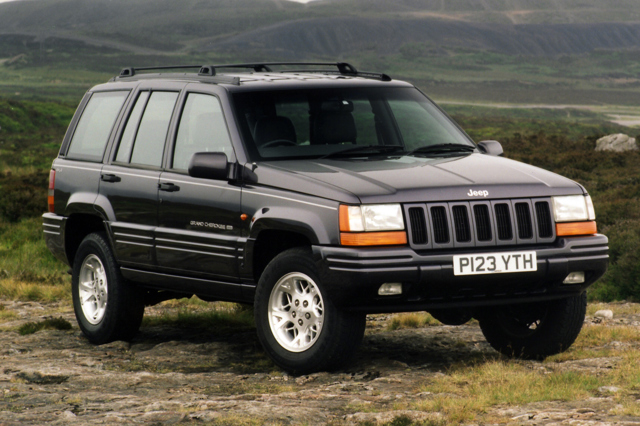
Development and Origins
The export-market story is documented in the factory literature itself: the 1998 export service manual is the right-hand-drive and diesel book, covering equipment the North American editions never mention.
The Grand Cherokee began as a replacement for the ageing AMC Cherokee, with development starting under American Motors Corporation before Chrysler's acquisition of AMC in 1987. Chrysler continued the programme, expanding the brief considerably. The aim was to produce a vehicle that could compete at the top of the SUV market rather than the middle of it.
The ZJ's design came from Chrysler's own studios under the direction of Trevor Creed. The brief called for a shape that looked purposeful without being aggressive, and interior quality that would satisfy buyers cross shopping against European luxury cars as much as against Land Rover. The unibody construction was an unusual choice for a serious off road vehicle of this era and reflected Chrysler's determination to achieve car like on road behaviour. The trade off, as owners eventually discovered, was that the structure needed to be kept free of corrosion to remain structurally sound.
The 4.0 litre AMC inline six engine, carried over from the XJ Cherokee, proved to be one of the better decisions in the vehicle's specification. It was already a proven unit with a strong reputation for durability and had the torque characteristics that suited a vehicle of this weight used in this way.
The UK Launch
Right hand drive production took place at Magna Steyr's plant in Graz, Austria, not at Chrysler's Jefferson North facility in Detroit where US cars were built. Graz handled all European and RHD ZJ production, including UK specification work: ECE compliant headlamps with the self levelling system required for MOT purposes, European rear fog lamps, and UK specific equipment groups.
Official UK sales opened in January 1996 through approximately 80 Chrysler Jeep franchised dealers. The Limited was the main offering at £28,995. The pitch to buyers was simple: more standard equipment than any comparable SUV, at a price that made Range Rover look poor value.
UK sales ran from January 1996 to 1999, with the WJ successor announced in mid 1998. The precise total of UK ZJ sales is not confirmed by data we can independently verify.
UK Timeline
| Sept 1995 | UK catalogue preparations. Limited specification confirmed. |
| Jan 1996 | Official RHD sales begin. 4.0 Limited at £28,995. |
| Feb 1997 | VM 2.5 turbodiesel added. Dual airbags standard across range. |
| 1997 | Orvis Edition reaches UK. Laredo added as entry level trim. Peak sales year. |
| June 1998 | WJ successor announced. ZJ production winds down. |
| 1999 | Remaining ZJ stock cleared. Some 1997/98 builds registered on S plates. |
The Model Code
Although commonly known as the ZJ, all RHD Jeep Grand Cherokees of this era actually carry the model code ZG.
Against the Range Rover
Chrysler's UK pitch was explicit. In 1996, a fully equipped Grand Cherokee Limited cost £28,995. A Range Rover Classic cost more and came with less. The Jeep offered automatic climate control, heated leather seats, a driver memory seat, cruise control and ABS as standard. The Range Rover did not. The Jeep's 4.0 litre engine had already proved itself over hundreds of thousands of miles in America. The Range Rover's 3.9-litre V8 was known for head gasket failures.
The comparison worked well for about three years. Then the WJ arrived, the ZJ went out of production, and without a current model to support the brand, UK interest faded. For those three years, the Grand Cherokee genuinely competed and, by most objective measures, won.
What the Press Said
"As capable as a Range Rover, better equipped, more reliable, and cheaper. Chrysler has made Land Rover look complacent." Period UK motoring press, 1996.
LHD Imports and UK registered Imports
Before the official UK launch in January 1996, a number of left hand drive US specification ZJs entered the UK through private import. These predate the right hand drive programme and are identifiable by left hand drive configuration, US specification lighting, and in most cases the 5.2 litre V8 engine, which was not available on UK market cars.
Analysing DVLA records for Grand Cherokee entries with manufacture years of 1995 and earlier suggests somewhere in the region of 30 to 50 left hand drive ZJs reached the UK before the official launch. This is an estimate: manufacture year data in the DVLA record is not always precise, and a small number of early right hand drive cars may be present in this cohort. The V8 engine is a useful secondary filter, since no UK market car left the factory with a V8. Any UK registered ZJ with a V8 engine is almost certainly a left hand drive US import.
A small number of V8 registered cars appear in the DVLA data, consistent with this estimate. A UK number plate does not confirm a UK specification car. The build sheet is the definitive record: look for "Right Hand Drive (RHD)", "RHD Optics Headlamps" and "United Kingdom Equipment Group". The absence of these entries on a V8 warrants caution.
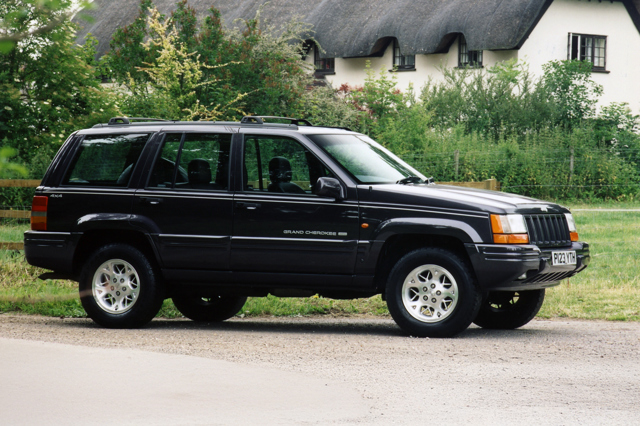
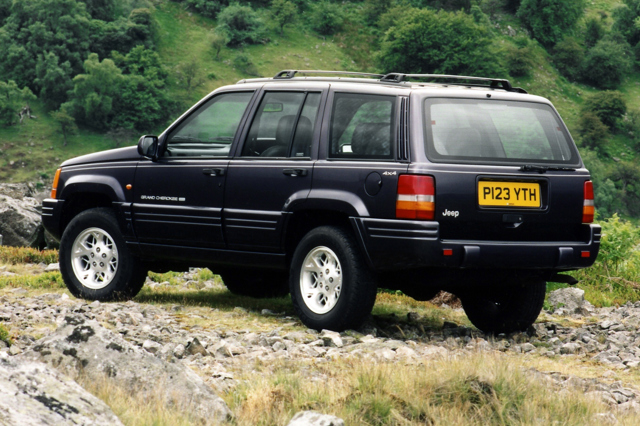
UK press photography 1996 and 1997. P plate registrations, British locations.
The 1996 Launch Brochure
The UK launch was built around a full colour dealer brochure dated January 1996, published by Chrysler Jeep Imports UK of Dover. Its pitch matched the one made to buyers across the showroom desk: this was a European built, right hand drive Jeep, sold as the ultimate go anywhere luxury car, with a specification that made the Range Rover look expensive. Chrysler also used the brochure to note its role as the founding UK sponsor member of the Tread Lightly responsible off roading programme.
We have scanned the brochure in full, together with a period dealer accessory price list. Both are free to download on the Literature page, where the launch specification and the original factory colours are set out in full.