Lubrication and Maintenance — 1998 Jeep Grand Cherokee ZJ Export Service Manual
Pages 13–28 · 15 pages · 5 words repaired
CLASSIFICATION OF LUBRICANTS
Only lubricants that are endorsed by the following organization should be used to service a Chrysler Corporation vehicle.
• Society of Automotive Engineers (SAE) • American Petroleum Institute (API) (Fig. 2) • National Lubricating Grease Institute (NLGI) (Fig. 3)
ENGINE OIL
SAE VISCOSITY RATING INDICATES ENGINE OIL VISCOSITY
An SAE viscosity grade is used to specify the viscosity of engine oil. SAE 30 specifies a single viscosity engine oil. Engine oils also have multiple viscosities. These are specified with a dual SAE viscosity grade which indicates the cold-to-hot temperature viscosity range.
• SAE 30 = single grade engine oil. • SAE 10W-30 = multiple grade engine oil.
API QUALITY CLASSIFICATION
The API Service Grade specifies the type of performance the engine oil is intended to provide. The API Service Grade specifications also apply to energy conserving engine oils.
Use engine oils that are API Service Certified. 5W-30 and 10W-30 MOPAR engine oils conform to specifications.
Refer to Group 9, Engine for engine oil specification.
GEAR LUBRICANTS
SAE ratings also apply to multiple grade gear lubricants. In addition, API classification defines the lubricants usage.
LUBRICANTS AND GREASES
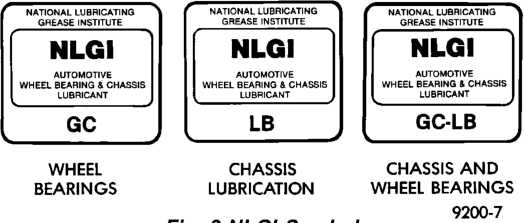
Lubricating grease is rated for quality and usage by the NLGI. All approved products have the NLGI symbol (Fig. 3) on the label. At the bottom NLGI symbol is the usage and quality identification letters. Wheel bearing lubricant is identified by the letter “G”. Chassis lubricant is identified by the latter “L”.
The letter following the usage letter indicates the quality of the lubricant. The following symbols indicate the highest quality.
FLUID CAPACITIES
FUEL TANK
All. . . . . . . . . . . . . . . . . . . . . . . . . . . .87.4 L (23 gal.)
ENGINE OIL W/FILTER CHANGE
4.0L . . . . . . . . . . . . . . . . . . . . . . . . . . .5.7 L (6.0 qts.) 5.2L . . . . . . . . . . . . . . . . . . . . . . . . . . .4.7 L (5.0 qts.) 5.9L . . . . . . . . . . . . . . . . . . . . . . . . . . .4.7 L (5.0 qts.)
COOLING SYSTEM
4.0L . . . . . . . . . . . . . . . . . . . . . . . .11.4 L (12.0 qts.)* 5.2L . . . . . . . . . . . . . . . . . . . . . . . .14.1 L (14.9 qts.)* 5.9L . . . . . . . . . . . . . . . . . . . . . . . .14.1 L (14.9 qts.)*
*Includes 2.2 L (2.3 qts.) for coolant recovery bottle.
AUTOMATIC TRANSMISSION
Dry fill capacity.*
42RE & 44RE . . . . . . . . . . . .9.3-11.7L (19.5-22 pts.) 46RE . . . . . . . . . . . . . . . . . . .9.2-13.3 L (19.5-28 pts.)
*Depending on type and size of internal cooler, length rary conlen; these figures may vary, Refer to Group 21
Transmission for proper fluid fill procedure.
TRANSFER CASE
242 NVG . . . . . . . . . . . . . . . . . . . . . . .1.4 L (3.0 pts.) 249 NVG . . . . . . . . . . . . . . . . . . . . . . .1.1 L (2.5 pts.)
FRONT AXLE
181 FBI . . . . . . . . . . . . . . . . . . . . . . .1.18 L (2.5 pts.)
REAR AXLE
194 RBI* . . . . . . . . . . . . . . . . . . . . . . .1.6 L (3.5 pts.) 216 RBA*. . . . . . . . . . . . . . . . . . . . .2.24 L (4.75 pts.)
*If the vehicle is equipped with TRAC-LOK, include 0.11 L (0.25 pts.) of friction modifier.
NOTE: Vehicles with trailer tow, must use a synthetic lubricant. Refer to Group 3, Differential and Driveline for service procedures.
GENERAL INFORMATION
INTRODUCTION . . . . . . . . . . . . . . . . . . . . . . . . . 3 SCHEDULE—A . . . . . . . . . . . . . . . . . . . . . . . . . . 3
GENERAL INFORMATION
INTRODUCTION
There are two maintenance schedules that show proper service intervals for ZJ vehicles. Use the schedule that best describes the conditions the vehicle is operated under. When mileage and time is listed, follow the interval that occurs first.
Schedule-A lists all the scheduled maintenance to be performed under normal operating conditions.
Schedule-B is a schedule for vehicles that are operated under the following conditions:
• Frequent short trips driving less than 5 miles (8 km)
• Frequent driving in dusty conditions • Extensive idling • Trailer towing • Sustained high speed operation • Off road driving • Desert operation • Frequent starting and stopping • Cold climate operation • Commercial service
EMISSION CONTROL SYSTEM MAINTENANCE
The scheduled emission maintenance listed in bold type on the Maintenance Schedules, must be done at the mileage specified to assure the continued proper functioning of the emission control system. These, and all other maintenance services included in this manual, should be done to provide the best vehicle performance and reliability. More frequent maintenance may be needed for vehicles in severe operating conditions such as dusty areas and very short trip driving.
UNSCHEDULED INSPECTION
AT EACH STOP FOR FUEL
• Check engine oil level, add as required. • Check windshield washer solvent and add if required.
MAINTENANCE SCHEDULES
INDEX
page page
SCHEDULE—B . . . . . . . . . . . . . . . . . . . . . . . . . . 5 UNSCHEDULED INSPECTION . . . . . . . . . . . . . . . 3
ONCE A MONTH
• Check tire pressure and look for unusual wear or damage.
• Inspect battery and clean and tighten terminals as required. Check electrolyte level and add water as needed.
• Check fluid levels of coolant reservoir, power steering and transmission and add as needed.
• Check all lights and all other electrical items for correct operation.
AT EACH OIL CHANGE
• Inspect exhaust system. • Inspect brake hoses. • Rotate the tires at each oil change interval shown on Schedule—A (7,500 miles) or every other interval shown on Schedule—B (6,000 miles). • Check coolant level, hoses and clamps. • Lubricate suspension ball joints. • After completion of off-road (4WD) operation, the underside of the vehicle should be thoroughly inspected. Examine threaded fasteners for looseness.
SCHEDULE—A
7,500 miles (12 000 km) or at 6 months
• Change engine oil. • Replace engine oil filter. • Lubricate steering linkage (4x4 only).
15,000 Miles (24 000 km) or at 12 months
• Change engine oil. • Replace engine oil filter. • Lubricate steering linkage.
22,500 Miles (36 000 km) or at 18 months
• Change engine oil. • Replace engine oil filter. • Lubricate steering linkage (4x4 only). • Inspect brake linings.
30,000 Miles (48 000 km) or at 24 months
• Change engine oil. • Replace engine oil filter. • Replace engine air cleaner element.
• Replace spark plugs. • Inspect drive belt. • Lubricate steering linkage. • Drain and refill automatic transmission fluid. • Drain and refill transfer case fluid.
37,500 Miles (60 000 km) or at 30 months
• Change engine oil. • Replace engine oil filter. • Lubricate steering linkage (4x4 only).
45,000 Miles (72 000 km) or at 36 months
• Change engine oil. • Replace engine oil filter. • Lubricate steering linkage. • Inspect brake linings. • Flush and replace engine coolant at 36 months, regardless of mileage.
52,500 Miles (84 000 km) or at 42 months
• Change engine oil. • Replace engine oil filter. • Lubricate steering linkage (4x4 only). • Flush and replace engine coolant if not done at 36 months.
60,000 Miles (96 000 km) or at 48 months
• Change engine oil. • Replace engine oil filter. • Replace engine air cleaner element. • Replace ignition wires. • Replace spark plugs. • Inspect PCV valve and replace if necessary (5.2L & 5.9L only).*
• Inspect drive belt. • Lubricate steering linkage. • Drain and refill automatic transmission fluid. • Drain and refill transfer case fluid. • Replace fuel filter.**
67,500 Miles (108 000 km) or at 54 months
• Change engine oil. • Replace engine oil filter. • Lubricate steering linkage (4x4 only). • Inspect brake linings.
75,000 Miles (120 000 km) or at 60 months
• Change engine oil. • Replace engine oil filter. • Lubricate steering linkage. • Flush and replace engine coolant if it has been 30,000 miles (48 000 km) or 24 months since last change.
82,500 Miles (132 000 km) or at 66 months
• Change engine oil. • Replace engine oil filter.
• Lubricate steering linkage (4x4 only). • Flush and replace engine coolant if it has been 30,000 miles (48 000 km) or 24 months since last change.
90,000 Miles (144 000 km) or at 72 months
• Change engine oil. • Replace engine oil filter. • Replace engine air cleaner element. • Replace spark plugs. • Inspect drive belt. • Lubricate steering linkage. • Drain and refill automatic transmission fluid. • Drain and refill transfer case fluid. • Inspect brake linings.
97,500 Miles (156 000 km) or at 78 months
• Change engine oil. • Replace engine oil filter. • Lubricate steering linkage (4x4 only).
105,000 Miles (168 000 km) or at 84 months
• Change engine oil. • Replace engine oil filter. • Lubricate steering linkage. • Flush and replace engine coolant if it has been 30,000 miles (48 000 km) or 24 months since last change.
112,500 Miles (180 000 km) or at 90 months
• Change engine oil. • Replace engine oil filter. • Lubricate steering linkage (4x4 only). • Inspect brake linings. • Flush and replace engine coolant if it has been 30,000 miles (48 000 km) or 24 months since last change.
120,000 Miles (192 000 km) or at 96 months
• Change engine oil. • Replace engine oil filter. • Replace engine air cleaner element. • Replace ignition wires. • Replace spark plugs. • Inspect PCV valve and replace if necessary (5.2L & 5.9L only).*
• Inspect drive belt. • Lubricate steering linkage. • Drain and refill automatic transmission fluid. • Drain and refill transfer case fluid. • Replace fuel filter.** *This maintenance is recommended, but is not required to maintain warranty on the PCV valve.
**Recommended for proper vehicle performance for vehicles built for sale in California.
IMPORTANT: Inspection and service should also be performed anytime a malfunction is observed or suspected.
SCHEDULE—B
3,000 Miles (5 000 km)
• Change engine oil. • Replace engine oil filter. • Lubricate steering linkage (4x4 only).
6,000 Miles (10 000 km)
• Change engine oil. • Replace engine oil filter. • Lubricate steering linkage (4x4 only).
9,000 Miles (14 000 km)
• Change engine oil. • Replace engine oil filter. • Lubricate steering linkage (4x4 only).
12,000 Miles (19 000 km)
• Change engine oil. • Replace engine oil filter. • Drain and refill automatic transmission fluid. • Drain and refill front and rear axles. • Lubricate steering linkage (4x4 only). • Inspect brake linings.
15,000 miles (24 000 km)
• Change engine oil. • Replace engine oil filter. • Inspect engine air cleaner element, replace as necessary.
• Lubricate steering linkage.
18,000 Miles (29 000 km)
• Change engine oil. • Replace engine oil filter. • Lubricate steering linkage (4x4 only).
21,000 Miles (34 000 km)
• Change engine oil. • Replace engine oil filter. • Lubricate steering linkage (4x4 only).
24,000 Miles (38 000 km)
• Change engine oil. • Replace engine oil filter. • Drain and refill automatic transmission fluid. • Drain and refill front and rear axles. • Lubricate steering linkage (4x4 only). • Inspect brake linings.
27,000 Miles (43 000 km)
• Change engine oil. • Replace engine oil filter.
• Lubricate steering linkage (4x4 only).
30,000 Miles (48 000 km)
• Change engine oil. • Replace engine oil filter. • Replace engine air cleaner element. • Inspect PCV valve and replace if necessary (5.2L & 5.9L only).*
• Replace spark plugs. • Inspect drive belt. • Drain and refill transfer case fluid. • Lubricate steering linkage.
33,000 Miles (53 000 km)
• Change engine oil. • Replace engine oil filter. • Lubricate steering linkage (4x4 only).
36,000 Miles (58 000 km)
• Change engine oil. • Replace engine oil filter. • Drain and refill automatic transmission fluid. • Drain and refill front and rear axles. • Lubricate steering linkage (4x4 only). • Inspect brake linings.
39,000 Miles (62 000 km)
• Change engine oil. • Replace engine oil filter. • Lubricate steering linkage (4x4 only).
42,000 Miles (67 000 km)
• Change engine oil. • Replace engine oil filter. • Lubricate steering linkage (4x4 only).
45,000 Miles (72 000 km)
• Change engine oil. • Replace engine oil filter. • Inspect engine air cleaner element, replace as necessary.
• Lubricate steering linkage.
48,000 Miles (77 000 km)
• Change engine oil. • Replace engine oil filter. • Drain and refill automatic transmission fluid. • Drain and refill front and rear axles. • Lubricate steering linkage (4x4 only). • Inspect brake linings.
51,000 Miles (82 000 km)
• Change engine oil. • Replace engine oil filter. • Flush and replace engine coolant. • Lubricate steering linkage (4x4 only).
54,000 Miles (86 000 km)
• Change engine oil. • Replace engine oil filter. • Lubricate steering linkage (4x4 only).
57,000 Miles (91 000 km)
• Change engine oil. • Replace engine oil filter. • Lubricate steering linkage (4x4 only).
60,000 Miles (96 000 km)
• Change engine oil. • Replace engine oil filter. • Replace engine air cleaner element. • Replace ignition wires. • Inspect PCV valve and replace if necessary (5.2L & 5.9L only).*
• Replace spark plugs. • Inspect drive belt. • Drain and refill automatic transmission fluid. • Drain and refill transfer case fluid. • Drain and refill front and rear axles. • Lubricate steering linkage. • Replace fuel filter.** • Inspect brake linings.
63,000 Miles (101 000 km)
• Change engine oil. • Replace engine oil filter. • Lubricate steering linkage (4x4 only).
66,000 Miles (106 000 km)
• Change engine oil. • Replace engine oil filter. • Lubricate steering linkage (4x4 only).
69,000 Miles (110 000 km)
• Change engine oil. • Replace engine oil filter. • Lubricate steering linkage (4x4 only).
72,000 Miles (115 000 km)
• Change engine oil. • Replace engine oil filter. • Drain and refill automatic transmission fluid. • Drain and refill front and rear axles. • Lubricate steering linkage (4x4 only). • Inspect brake linings.
75,000 Miles (120 000 km)
• Change engine oil. • Replace engine oil filter. • Inspect engine air cleaner element, replace as necessary.
• Lubricate steering linkage.
78,000 Miles (125 000 km)
• Change engine oil. • Replace engine oil filter. • Lubricate steering linkage (4x4 only).
81,000 Miles (130 000 km)
• Change engine oil. • Replace engine oil filter. • Flush and replace engine coolant. • Lubricate steering linkage (4x4 only).
84,000 miles (134 000 km)
• Change engine oil. • Replace engine oil filter. • Drain and refill automatic transmission fluid. • Drain and refill front and rear axles. • Lubricate steering linkage (4x4 only). • Inspect brake linings.
87,000 Miles (139 000 km)
• Change engine oil. • Replace engine oil filter. • Lubricate steering linkage (4x4 only).
90,000 Miles (144 000 km)
• Change engine oil. • Replace engine oil filter. • Replace engine air cleaner element. • Inspect PCV valve and replace if necessary (5.2L & 5.9L only).*
• Replace spark plugs. • Inspect drive belt. • Drain and refill transfer case fluid. • Lubricate steering linkage.
93,000 Miles (149 000 km)
• Change engine oil. • Replace engine oil filter. • Lubricate steering linkage (4x4 only).
96,000 Miles (154 000 km)
• Change engine oil. • Replace engine oil filter. • Drain and refill automatic transmission fluid. • Drain and refill front and rear axles. • Lubricate steering linkage (4x4 only). • Inspect brake linings.
99,000 Miles (158 000 km)
• Change engine oil. • Replace engine oil filter. • Lubricate steering linkage (4x4 only).
102,000 Miles (163 000 km)
• Change engine oil. • Replace engine oil filter. • Lubricate steering linkage (4x4 only).
105,000 Miles (168 000 km)
• Change engine oil. • Replace engine oil filter. • Inspect engine air cleaner element, replace as necessary.
• Lubricate steering linkage.
108,000 Miles (173 000 km)
• Change engine oil. • Replace engine oil filter. • Drain and refill automatic transmission fluid. • Drain and refill front and rear axles. • Lubricate steering linkage (4x4 only). • Inspect brake linings.
111,000 Miles (178 000 km)
• Change engine oil. • Replace engine oil filter. • Flush and replace engine coolant. • Lubricate steering linkage (4x4 only).
114,000 Miles (182 000 km)
• Change engine oil. • Replace engine oil filter. • Lubricate steering linkage (4x4 only).
117,000 Miles (187 000 km)
• Change engine oil. • Replace engine oil filter.
• Lubricate steering linkage (4x4 only).
120,000 Miles (192 000 km)
• Change engine oil. • Replace engine oil filter. • Replace engine air cleaner element. • Replace ignition wires. • Replace spark plugs. • Inspect PCV valve and replace if necessary (5.2L & 5.9L only).
• Inspect drive belt. • Drain and refill automatic transmission fluid. • Drain and refill transfer case fluid. • Drain and refill front and rear axles. • Lubricate steering linkage. • Replace fuel filter.** • Inspect brake linings. *This maintenance is recommended, but is not required to maintain warranty on the PCV valve.
**Recommended for proper vehicle performance for vehicles built for sale in California.
IMPORTANT: Inspection and service should also be performed anytime a malfunction is observed or suspected.
SERVICE PROCEDURES
EMERGENCY TOW HOOKS . . . . . . . . . . . . . . . . 10 FOUR-WHEEL-DRIVE VEHICLE TOWING . . . . . 10 HOISTING RECOMMENDATIONS . . . . . . . . . . . 10
SERVICE PROCEDURES
JUMP STARTING PROCEDURE
WARNING: REVIEW ALL SAFETY PRECAUTIONS AND WARNINGS IN GROUP 8A, BATTERY/START- ING/CHARGING SYSTEMS DIAGNOSTICS. DO NOT JUMP START A FROZEN BATTERY, PERSONAL INJURY CAN RESULT. DO NOT JUMP START WHEN MAINTENANCE FREE BATTERY INDICATOR DOT IS YELLOW OR BRIGHT COLOR. DO NOT JUMP START A VEHICLE WHEN THE BATTERY FLUID IS BELOW THE TOP OF LEAD PLATES. DO NOT ALLOW JUMPER CABLE CLAMPS TO TOUCH EACH OTHER WHEN CONNECTED TO A BOOSTER SOURCE. DO NOT USE OPEN FLAME NEAR BAT- TERY. REMOVE METALLIC JEWELRY WORN ON HANDS OR WRISTS TO AVOID INJURY BY ACCI- DENTAL ARCING OF BATTERY CURRENT. WHEN USING A HIGH OUTPUT BOOSTING DEVICE, DO NOT ALLOW BATTERY VOLTAGE TO EXCEED 16 VOLTS. REFER TO INSTRUCTIONS PROVIDED WITH DEVICE BEING USED.
CAUTION: When using another vehicle as a booster, do not allow vehicles to touch. Electrical systems can be damaged on either vehicle.
TO JUMP START A DISABLED VEHICLE:
(1) Raise hood on disabled vehicle and visually inspect engine compartment for: • Battery cable clamp condition, clean if necessary. • Frozen battery. • Yellow or bright color test indicator, if equipped. • Low battery fluid level. • Generator drive belt condition and tension. • Fuel fumes or leakage, correct if necessary.
CAUTION: If the cause of starting problem on disabled vehicle is severe, damage to booster vehicle charging system can result.
(2)
When using another vehicle as a booster source, set the parking brake, place the automatic
INDEX
page page
JUMP STARTING PROCEDURE . . . . . . . . . . . . . . 8 TOWING RECOMMENDATIONS . . . . . . . . . . . . . . 9 TWO-WHEEL-DRIVE VEHICLE TOWING . . . . . . . 9 transmission in PARK or the manual transmission in
NEUTRAL and turn the ignition OFF.
(3)
On disabled vehicle, place gear selector in park or neutral and set park brake. Turn off all accessories.
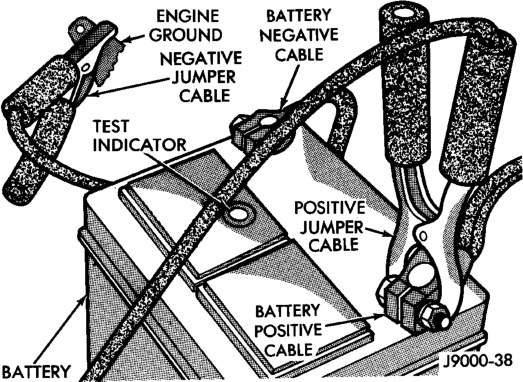
(4) Connect jumper cables to booster battery. RED clamp to positive terminal (+). BLACK clamp to negative terminal (-). DO NOT allow clamps at opposite end of cables to touch, electrical arc will result. Review all warnings in this procedure.
(5) On disabled vehicle, connect RED jumper cable clamp to positive (+) terminal. Connect BLACK jumper cable clamp to engine ground as close to the ground cable attaching point as possible (Fig. 1).
(6) Start the engine in the vehicle which has the booster battery, let the engine idle a few minutes, then start the engine in the vehicle with the discharged battery.
CAUTION: Do not crank starter motor on disabled vehicle for more than 15 seconds, starter will overheat and could fail.
(7) Allow battery in disabled vehicle to charge to at least 12.4 volts (75% charge) before attempting to start engine. If engine does not start within 15 seconds, stop cranking engine and allow starter to cool (15 min.), before cranking again.
DISCONNECT CABLE CLAMPS AS FOLLOWS:
• Disconnect BLACK cable clamp from engine ground on disabled vehicle.
•
When using a Booster vehicle, disconnect BLACK cable clamp from battery negative terminal. Disconnect
RED cable clamp from battery positive terminal.
• Disconnect RED cable clamp from battery positive terminal on disabled vehicle.
TOWING RECOMMENDATIONS
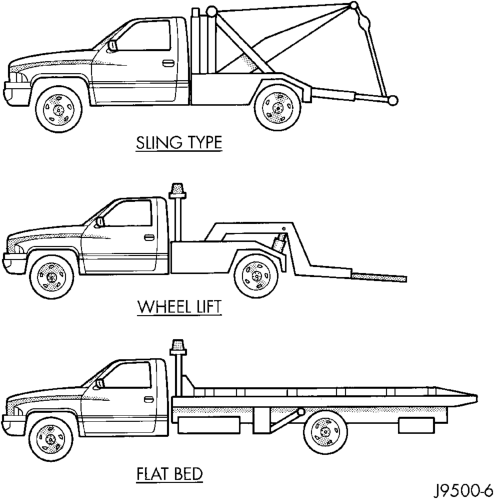
A vehicle equipped with SAE approved sling-type towing equipment or a wheel-lift towing device can be used to tow all ZJ vehicles. When towing a 4WD vehicle, use tow dollies under the opposite end of the vehicle. A vehicle with a flat-bed device can also be used to transport a disabled vehicle (Fig. 2).
SAFETY PRECAUTIONS
The following safety precautions must be observed when towing a vehicle:
• Secure loose and protruding parts. • Always use a safety chain system that is independent of the lifting and towing equipment.
• Do not allow towing equipment to contact the disabled vehicle's fuel tank.
• Do not allow anyone under the disabled vehicle while it is lifted by the towing device.
• Do not allow passengers to ride in a vehicle being towed.
• Always observe state and local laws regarding towing regulations.
• Do not tow a vehicle in a manner that could jeopardize the safety of the operator, pedestrians or other motorists.
• Do not attach tow chains, T-hooks, J-hooks, or a tow sling to a bumper, steering linkage, drive shafts or a non-reinforced frame hole.
GROUND CLEARANCE
CAUTION: If vehicle is towed with wheels removed, install lug nuts to retain brake drums.
A towed vehicle should be raised until lifted wheels are a minimum 100 mm (4 in) from the ground. Be sure there is adequate ground clearance at the opposite end of the vehicle, especially when towing over rough terrain or steep rises in the road. If necessary, remove the wheels from the lifted end of the vehicle and lower the vehicle closer to the ground, to increase the ground clearance at the opposite end of the vehicle. Install lug nuts on wheel attaching studs to retain brake drums.
FLAT-BED TOWING RAMP ANGLE
If a vehicle with flat-bed towing equipment is used, the approach ramp angle should not exceed 15 degrees.
TWO-WHEEL-DRIVE VEHICLE TOWING
Chrysler Corporation recommends that a vehicle be towed with the rear end lifted, whenever possible.
WARNING: WHEN TOWING A DISABLED VEHICLE AND THE DRIVE WHEELS ARE SECURED IN A WHEEL LIFT OR TOW DOLLIES, ENSURE THE TRANSMISSION IS IN THE PARK POSITION (AUTO- MATIC TRANSMISSION) OR A FORWARD DRIVE GEAR (MANUAL TRANSMISSION).
TOWING-REAR END LIFTED
CAUTION: Do not use steering column lock to secure steering wheel during towing operation.
Vehicles can be towed with the front wheels on the ground for extended distances at speeds not exceeding 48 km/h (30 mph). (1) Attach the J-hooks around the axle shaft tube outboard of the rear springs.
(2) Position and center the sling under and forward of the rear bumper.
(3) Attach safety chains (with pads) at each end of the rear bumper.
(4) Turn the ignition switch to the OFF position to unlock the steering wheel.
(5) Secure the steering wheel in straight ahead position with a clamp device designed for towing.
(6) Verify that steering components are in good condition.
(7) Shift the transmission to NEUTRAL.
TOWING-FRONT END LIFTED
To prevent damage to front fascia components, use only a Wheel-Lift type towing device or Flat-Bed hauling equipment.
If using the wheel-lift towing method, install tow dollies under rear wheels.
FOUR-WHEEL-DRIVE VEHICLE TOWING
Chrysler Corporation recommends that a vehicle be transported on a flat-bed device. A Wheel-lift or Sling-type device can be used provided all the wheels are lifted off the ground using tow dollies.
WARNING: WHEN TOWING A DISABLED VEHICLE AND THE DRIVE WHEELS ARE SECURED IN A WHEEL LIFT OR TOW DOLLIES, ENSURE THE TRANSMISSION IS IN THE PARK POSITION (AUTO- MATIC TRANSMISSION) OR A FORWARD DRIVE GEAR (MANUAL TRANSMISSION).
4WD TOWING-REAR END LIFTED
(1) Raise the front of the vehicle off the ground and install tow dollies under front wheels.
(2) Attach the J-hooks around the axle shaft tube outboard of the rear springs.
(3) Position and center the sling under and forward of the rear bumper.
(4) Attach safety chains (with pads) at each end of the rear bumper.
(5) Turn the ignition switch to the OFF position to unlock the steering wheel.
(6) Secure the steering wheel in straight ahead position with a clamp device designed for towing.
4WD TOWING-FRONT END LIFTED
To prevent damage to front fascia components, use only a Wheel-Lift type towing device or Flat-Bed hauling equipment.
If using the wheel-lift towing method, install tow dollies under rear wheels.
EMERGENCY TOW HOOKS
WARNING: REMAIN AT A SAFE DISTANCE FROM A VEHICLE THAT IS BEING TOWED VIA ITS TOW HOOKS. THE TOW STRAPS/CHAINS COULD BREAK AND CAUSE SERIOUS INJURY.
Some Jeep vehicles are equipped with front emergency tow hooks. The tow hooks should be used for EMERGENCY purposes only.
CAUTION: DO NOT use emergency tow hooks for tow truck hook-up or highway towing.
HOISTING RECOMMENDATIONS
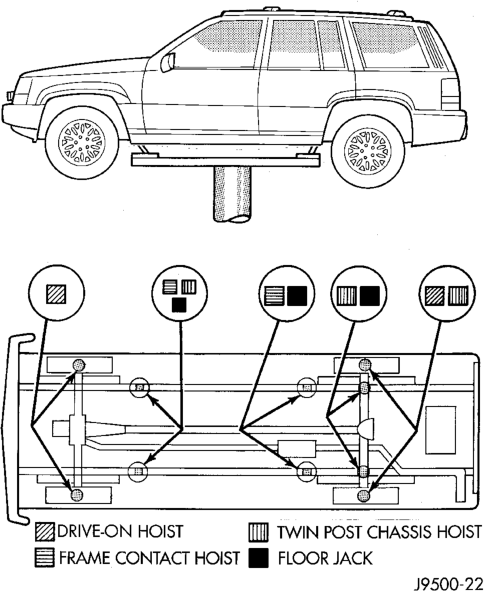
FLOOR JACK
When properly positioned, a floor jack can be used to lift a ZJ vehicle (Fig. 3). Support the vehicle in the raised position with jack stands at the front and rear ends of the frame rails.
CAUTION: Do not attempt to lift a vehicle with a floor jack positioned under:
• An axle tube. • Aluminum differential. • A body side sill. • A steering linkage component. • A drive shaft. • The engine or transmission oil pan. • The fuel tank. • A front suspension arm.
HOIST
A vehicle can be lifted with: • A single-post, frame-contact hoist. • A twin-post, chassis hoist. • A ramp-type, drive-on hoist.
NOTE: When a frame-contact type hoist is used, verify that the lifting pads are positioned properly (Fig. 3).
WARNING: THE HOISTING AND JACK LIFTING POINTS PROVIDED ARE FOR A COMPLETE VEHI- CLE. WHEN A CHASSIS OR DRIVETRAIN COMPO- NENT IS REMOVED FROM A VEHICLE, THE CENTER OF GRAVITY IS ALTERED MAKING SOME HOISTING CONDITIONS UNSTABLE. PROPERLY SUPPORT OR SECURE VEHICLE TO HOISTING DEVICE WHEN THESE CONDITIONS EXIST.
GENERAL INFORMATION
MAINTENANCE SCHEDULE—DIESEL ENGINE . 2
GENERAL INFORMATION
MAINTENANCE SCHEDULE—DIESEL ENGINE
The following are engine related Maintenance items which are unique to Diesel engine-equipped vehicles. Refer to the 1997 ZJ Service Manual for gasoline engine and non-engine related Maintenance Schedules.
The service intervals are based on odometer readings in kilometers. There are two maintenance schedules that show proper service intervals. Use the schedule that best describes the conditions the vehicle is operated under. Schedule-A lists all the scheduled maintenance to be performed under normal operating conditions. Schedule-B is the schedule for vehicles that are operated under one or more of the following conditions:
• Day and night temperatures are below freezing. • Stop and go driving. • Long periods of engine idling. • Driving in dusty conditions. • Short trips of less than 8 kilometers (5 miles). • Operation at sustained high speeds during hot weather above 32°C (90°F).
• Taxi, police or delivery service. • Trailer towing.
AT EACH STOP FOR FUEL OR SCHEDULED
SERVICE STOP
• Check engine oil level. • Check engine coolant level. • Inspect drive belt. • Visually inspect intercooler for obstruction. Clean as necessary.
• Visually inspect radiator for obstruction. Clean as necessary.
• Inspect for fuel, oil or coolant leaks. • Inspect battery cable connection and excessive corrosion.
• Inspect for presence of water in fuel filter/water separator, drain if necessary.
SCHEDULE—A
1 000 KM
• Change engine oil. • Change engine oil filter.
MAINTENANCE SCHEDULE
INDEX
page page
SCHEDULE—A . . . . . . . . . . . . . . . . . . . . . . . . . 2 SCHEDULE—B . . . . . . . . . . . . . . . . . . . . . . . . . 3
• Check all fluid levels. • Check correct torque, intake manifold mounting nuts.
• Check correct torque, exhaust manifold mounting nuts. • Check correct torque, turbocharger mounting nuts.
• Check correct torque, water manifold bolts.
10 000 KM
• Change engine oil. • Change engine oil filter.
20 000 KM
• Change engine oil. • Change engine oil filter. • Replace air filter element. • Check drive belt tension. • Check glow plug operation. • Retorque cylinder head bolts.* * Engines equipped with a steel head gasket do not need this service procedure performed. Refer to Group 9, Engines for head gasket identification.
30 000 KM
• Change engine oil. • Change engine oil filter.
40 000 KM
• Change engine oil. • Change engine oil filter. • Replace air filter element. • Check drive belt tension. • Check glow plug operation. • Replace fuel filter/water separator element.**
50 000 KM
• Change engine oil. • Change engine oil filter.
60 000 KM
• Change engine oil. • Change engine oil filter. • Replace air filter element. • Check glow plug operation. • Replace drive belt. • Check engine smoke. • Replace engine coolant.
70 000 KM
• Change engine oil. • Change engine oil filter.
80 000 KM
• Change engine oil. • Change engine oil filter. • Replace air filter element. • Check drive belt tension. • Check glow plug operation. • Replace fuel filter/water separator element.**
90 000 KM
• Change engine oil. • Change engine oil filter.
100 000 KM
• Change engine oil. • Change engine oil filter. • Replace air filter element. • Check drive belt tension. • Check glow plug operation.
EVERY 40 000 KM AFTER 80 000 KM
• Replace fuel filter/water separator element.** **The fuel filter/water separator element should be replaced once a year if the vehicle is driven less than 40 000 km annually or if power loss from fuel starvation is detected.
EVERY 10 000 KM AFTER 100 000 KM
• Change engine oil. • Change engine oil filter.
EVERY 20 000 KM AFTER 100 000 KM
• Change engine oil. • Change engine oil filter. • Replace air filter element. • Check drive belt tension. • Check glow plug operation.
SCHEDULE—B
500 KM
• Check correct torque, intake manifold mounting nuts.
• Check correct torque, exhaust manifold mounting nuts.
• Check correct torque, turbocharger mounting nuts.
• Check correct torque, water manifold bolts.
1 000 KM
• Change engine oil. • Change engine oil filter. • Check all fluid levels.
5 000 KM
• Change engine oil. • Change engine oil filter.
10 000 KM
• Change engine oil. • Change engine oil filter. • Replace air filter element. • Check drive belt tension. • Check glow plug operation.
15 000 KM
• Change engine oil. • Change engine oil filter.
20 000 KM
• Change engine oil. • Change engine oil filter. • Replace air filter element. • Check drive belt tension. • Check glow plug operation. • Retorque cylinder head bolts.* * Engines equipped with a steel head gasket do not need this service procedure performed. Refer to Group 9, Engines for head gasket identification.
25 000 KM
• Change engine oil. • Change engine oil filter.
30 000 KM
• Change engine oil. • Change engine oil filter. • Replace air filter element. • Check glow plug operation. • Replace drive belt. • Check engine smoke. • Replace engine coolant.
35 000 KM
• Change engine oil. • Change engine oil filter.
40 000 KM
• Change engine oil. • Change engine oil filter. • Replace air filter element. • Check drive belt tension.
• Check glow plug operation. • Replace fuel filter/water separator element.
45 000 KM
• Change engine oil. • Change engine oil filter.
50 000 KM
• Change engine oil. • Change engine oil filter. • Replace air filter element. • Check drive belt tension. • Check glow plug operation.
55 000 KM
• Change engine oil. • Change engine oil filter.
60 000 KM
• Change engine oil. • Change engine oil filter. • Replace air filter element. • Check drive belt tension. • Check glow plug operation. • Replace fuel filter/water separator element.
65 000 KM
• Change engine oil. • Change engine oil filter.
70 000 KM
• Change engine oil. • Change engine oil filter. • Replace air filter element. • Check drive belt tension. • Check glow plug operation.
75 000 KM
• Change engine oil. • Change engine oil filter.
80 000 KM
• Change engine oil. • Change engine oil filter.
• Replace air filter element. • Check glow plug operation. • Replace drive belt. • Check engine smoke. • Replace engine coolant.
85 000 KM
• Change engine oil. • Change engine oil filter.
90 000 KM
• Change engine oil. • Change engine oil filter. • Replace air filter element. • Check drive belt tension. • Check glow plug operation.
95 000 KM
• Change engine oil. • Change engine oil filter.
100 000 KM
• Change engine oil. • Change engine oil filter. • Replace air filter element. • Check drive belt tension. • Check glow plug operation. • Replace fuel filter/water separator element.
EVERY 5 000 KM AFTER 100 000 KM
• Change engine oil. • Change engine oil filter.
EVERY 10 000 KM AFTER 100 000 KM
• Change engine oil. • Change engine oil filter. • Replace air filter element. • Check drive belt tension. • Check glow plug operation.
EVERY 20 000 KM AFTER 100 000 KM
• Replace fuel filter/water separator element.